Battery & Starter Loans from OpenRoad Lending: Fix the System That Starts Everything
A battery and starter loan through OpenRoad Lending's network puts $500 to $5,000 behind starting-system repairs — batteries, starters, alternators, and wiring — repaid in fixed monthly installments you approve in advance.
No repair category strands more Americans on more mornings than the starting system. A battery quits in a cold snap, a starter clicks once and retires, an alternator fails and takes a fresh battery down with it. This OpenRoad Lending guide covers the honest auto repair loan costs, the tests that tell battery from starter, and how an OpenRoad Lending auto repair loan handles the awkward truth of electrical work: the invoice is rarely just one part. If a late-night search for open road finance help brought you here with the hood already up, start with the cost table below and work outward through each auto repair loan band.

Battery & Starter Loan Bands
Starting-system financing clusters in three bands: $500 to $1,000 for battery-plus-extras invoices, $1,000 to $2,000 for starter or alternator replacements, and $2,000 to $3,500 for compound electrical repairs.
A quality battery, terminals, cables, and the diagnostic that found the real culprit — one tidy auto repair loan instead of a drained account.
Request this rangeThe two big single-part failures of the charging circuit, with labor that varies wildly by engine layout.
Request this rangeAlternator plus battery plus wiring damage — the cascade failures that make one auto repair loan smarter than three.
Request this rangeThe $500 auto repair loan minimum is why bundling matters here: a bare battery swap sits below it, but the real-world invoice — battery, terminals, testing, shop labor, tax — usually clears the auto repair loan floor comfortably.
Battery or Starter? Reading the Symptoms Like a Technician
Slow cranking that improves with a jump points to the battery; a single click or grind with healthy lights points to the starter; a car that starts but dies, or a battery that keeps dying, points to the alternator.
Shops confirm in minutes with three checks. A load test measures whether the battery holds voltage under demand. A voltage-drop test at the starter finds bad cables and corroded grounds — the cheap fixes hiding behind expensive symptoms. A charging-system test verifies the alternator is pushing roughly 13.5 to 14.5 volts back into the battery while running. Insist on all three tests before authorizing auto repair loan money for parts, because the most common electrical overcharge in America is a new starter bolted onto a car that needed a $40 ground strap.
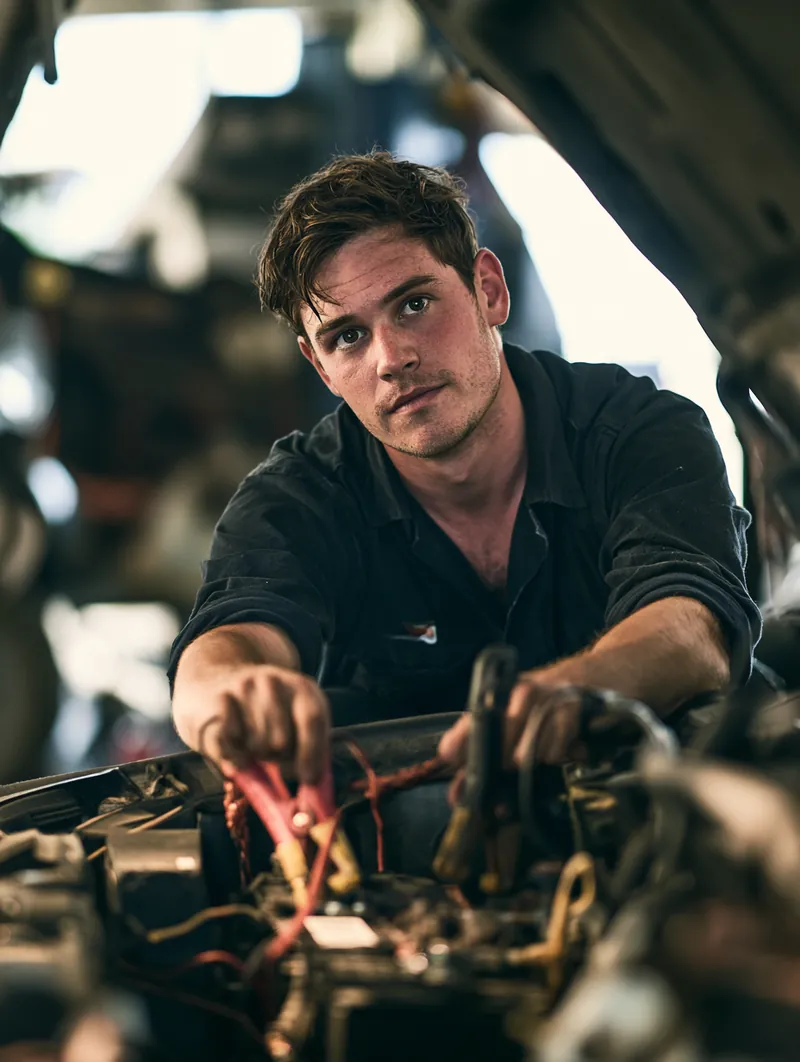
Our field guide 7 Warning Signs Your Battery or Starter Is About to Fail teaches the sounds and dashboard hints — reviews for open road lending often cite it as the article that saved a tow that show up days before the no-start morning — worth a read from the OpenRoad Lending library even if today's crisis is already at the shop.
What Starting-System Repairs Cost
Typical U.S. pricing: $150 to $350 for a battery installed, $350 to $750 for a starter, $450 to $900 for an alternator, and $100 to $250 for cable and terminal repairs, with AGM batteries adding $50 to $150.
| Repair | Typical range | Watch for |
|---|---|---|
| Flooded battery, installed | $150 – $280 | Group size and cold-cranking amps must match spec |
| AGM battery, installed | $200 – $400 | Required by most start-stop vehicles |
| Terminals, cables, grounds | $100 – $250 | The cheap fix misdiagnosed most often |
| Starter replacement | $350 – $750 | Labor spread is huge — access varies by engine |
| Alternator replacement | $450 – $900 | Test the battery after; failures kill batteries |
| Parasitic-draw diagnosis | $100 – $200 | For batteries that die overnight repeatedly |
| Alternator + battery combo | $650 – $1,300 | The most common compound invoice in this category |
Pricing detail by battery type, brand tier, and store-versus-shop installation lives in the OpenRoad Lending battery replacement cost guide, and it pairs the numbers with the questions that keep invoices honest.
Why Starting Systems Fail When They Do
Heat quietly damages batteries all summer, cold exposes that damage on the first freezing morning, and age catches starters and alternators mostly between 100,000 and 150,000 miles.
The seasonal spike is predictable enough that shops staff for it. Sustained heat evaporates electrolyte and warps internal plates; the battery then holds just enough charge until a cold snap doubles the cranking load, and the 7 a.m. no-start is born. A battery past four years in a hot state, or five anywhere else, is living on borrowed time. Starters and alternators are simply wear items — brushes, bearings, and windings with a finite service life — which is why a high-mileage car often needs both within the same year and why the compound band above exists. None of this is bad luck; it is a maintenance calendar written in amperage, and an auto repair loan is the OpenRoad Lending tool for the mornings the calendar wins.
A Small Loan, Priced Honestly: Representative Example
Representative example: an $800 auto repair loan repaid over 6 months at 30% APR costs about $145 per month, for a total repayment of roughly $871 — an estimate until a lender's written offer replaces it.
Small auto repair loan balances carry the highest APRs in lending, so short terms are your friend: in that example, roughly $71 of interest buys six months of spreading, and paying it off in four months shrinks the cost further since most lenders in the OpenRoad Lending network skip prepayment penalties. Compare that against an overdraft cascade or a maxed card and the fixed payoff date usually wins. Model your own numbers in the auto repair loan calculator, then read what moves small-balance pricing in the rates guide. The eligibility page lists the light paperwork these smaller requests need — for most borrowers, an ID, a pay stub, and an active checking account.
Why Route Battery & Starter Work Through OpenRoad Lending
OpenRoad Lending fits this category because the network prices small, short auto repair loan requests seriously — the $500 to $1,500 zone many lenders treat as an afterthought.
Plenty of financing brands chase the $5,000 borrower and sleepwalk through the $700 one. OpenRoad Lending's network was assembled the other way: starting-system invoices are the most common request we see, so soft-inquiry first steps, next-business-day deposits, and short 3-to-12-month terms are the default experience rather than the exception. Funds land in your checking account, which keeps a $240 battery quote from mysteriously becoming a $340 one when financing enters the conversation — the shop never needs to know how you are paying. Our record on exactly these small requests fills the open road lending reviews hub: a 4.54-star average across 12,600 ratings, with battery-and-starter customers among the most represented.
If you are cross-shopping — and you should — our 20-lender comparison profiles the brands that show up beside us in open road loans searches, including repair-specific financers and small installment lenders. Readers hunting reviews for open road lending will find our three-star feedback published as plainly as the fives; an OpenRoad Lending habit we would rather over-explain than hide.
One Invoice, One Loan: The Bundling Principle
Bundle every starting-system item — battery, cables, labor, diagnosis, tax — into a single auto repair loan request, because one loan is cheaper to originate, simpler to track, and easier to pay off early than several small ones.
Electrical failures cascade, and financing should not cascade with them. Two separate $600 requests can mean two underwriting passes, two payment dates, and on some products two origination fees; one $1,200 auto repair loan means one fixed payment and one payoff party. Ask the shop to write everything on a single estimate, including the almost-failed items their testing surfaced, then size the auto repair loan to that page. The OpenRoad Lending form takes unrounded amounts on purpose — $1,140 is a perfectly good number. The one caution: bundling is for related work discovered honestly, not for padding. If a battery visit somehow grows struts, ask why before you finance the answer; OpenRoad Lending's own guides on rates will show you exactly what each padded hundred costs over a term.
Parts Store, Mobile Installer, or Repair Shop?
Parts stores install batteries cheapest, mobile installers price convenience into every part, and repair shops cost more per item but catch the cable, ground, and alternator problems the other two miss.
Because an auto repair loan through OpenRoad Lending pays you rather than a merchant, all three doors stay open. A healthy car with a simply dead battery does fine at a parts store, where installation is often free with purchase. A car that strands you at home makes the mobile installer's premium — commonly $50 to $120 over store pricing — money well spent. Repeated failures belong at a shop, because repeat failures are almost never the battery's fault. Whichever door you choose, keep the receipt and warranty card with your auto repair loan paperwork; battery warranties are prorated by month, and drivers comparing open road finance options often forget the warranty refund that could shrink the next invoice.
Small Loans, Real Credit Footprints
A small auto repair loan repaid on time is reported to credit bureaus by many lenders, which means a $700 battery-and-starter fix can quietly become six months of positive payment history.
This cuts both ways, and OpenRoad Lending would rather say so plainly. On-time installments on an auto repair loan add the payment-history data that credit scores weigh most heavily, and several borrowers in our open road loans traffic tell us a repaid starter loan was the first positive tradeline they ever built. Miss payments and the same reporting works against you just as efficiently. Treat the smallest loan with the same calendar discipline as a mortgage: autopay on, due date two days after your pay date, statement checked monthly. The OpenRoad Lending eligibility guide covers which documents help thin-credit applicants most, and our FAQ answers the soft-versus-hard inquiry question in detail before you ever submit.
Make This the Last Starting-System Loan for Years
Twice-yearly terminal cleaning, an annual load test after year three, and replacing the battery on schedule rather than at failure will keep most drivers out of this category for half a decade.
The starting system rewards cheap attention like nothing else on the car. A $15 terminal brush and ten minutes each spring and fall prevents the corrosion that kills cables. Free load tests at most parts stores turn battery death from a surprise into an appointment. Replacing a five-year-old battery proactively costs the same as replacing it in a tow-truck parking lot, minus the tow. Set the final payment date of this auto repair loan as your first test reminder, and the odds say your next battery is a planned $200 errand instead of a financed morning. That arc — crisis, fix, habit — is the outcome OpenRoad Lending is actually selling, and the quiet reason our repeat visitors mostly come back to read rather than to borrow.
Frequently Asked Questions
Why finance a battery when replacements start around $150?
A basic battery swap is affordable for most budgets, but the real bill often includes a starter, alternator, or corroded cabling discovered during testing. When the combined invoice reaches $500 or more, a small fixed-payment loan can be easier than draining savings.
How do I know whether it is the battery or the starter?
A battery problem usually shows slow cranking, dim lights, and improvement after a jump start. A starter problem tends to produce a single click or grinding with normal lights and no improvement from jumping. A shop can confirm with a quick electrical test.
Are AGM batteries worth the higher price?
Vehicles with start-stop systems or heavy electronics are usually designed for AGM batteries, which cost roughly $200 to $400 but last longer under those loads. Installing a cheaper flooded battery in an AGM-spec car often shortens its life and can trigger warnings.
Will a lender care what part brand my shop installs?
No. Unsecured auto repair loans arranged through OpenRoad Lending are paid to you, so you and your mechanic choose the parts. Ask the shop to quote both economy and premium options so you can borrow only what the job truly needs.